The ₹15 Chai That Quietly Turned Into a ₹45 Sale
It was a regular Tuesday evening at a Yewale Amruttulya outlet in Pune. Around 5:30 PM, a tired office worker walked in. He wanted one thing: his usual cutting chai before heading home. Nothing else.
But as he waited at the counter, his eyes landed on the display shelf. A golden, flaky Cream Roll sat right at eye level, perfectly shaped, looking like it had been put there just for him.
He pointed to it. "One of those too."
His bill went from ₹15 to ₹40.
Now think about this. If 60 customers did the same thing that evening, that is ₹1,500 in snack revenue from a single rush hour. No extra cups of tea brewed. No new customers brought in. No extra staff hired. Just one small item sitting on the right shelf at the right time.
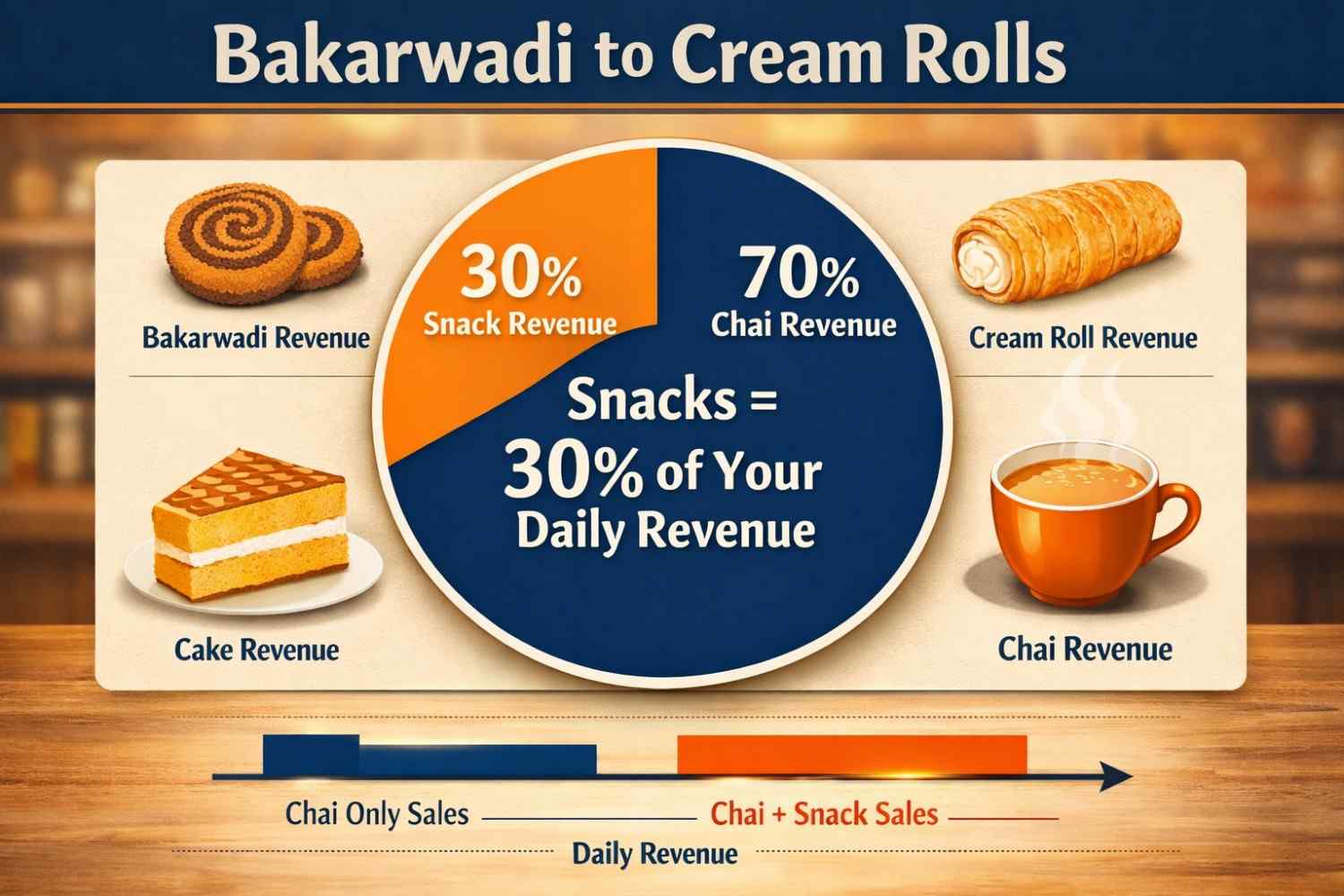
Here is the surprising truth: at most tea outlets in India, snacks are treated as a side note. But the data tells a completely different story. Snacks can account for 28% to 35% of your total daily revenue when managed the right way.
This blog breaks down exactly how that happens, why most tea stall owners miss it, and what the right snack strategy looks like for a tea franchise in India.
India's Snack Market Is Growing Fast. Every Tea Outlet Has a Front-Row Seat.
Most people think of a tea business as a beverage business. That is the first mistake. The strongest tea shop franchise in India has always been a snack-plus-chai business, because that is how Indian tea culture actually works.
Look at where the market is heading:
• Market size: The India snacks market was valued at INR 46,571 crore in 2024 and is projected to nearly double to INR 1,01,811 crore by 2033, growing at a CAGR of 8.63%.
• Ethnic snacks segment: Traditional and regional snack formats stood at USD 4.56 billion in 2024, with the namkeen and savory sub-segment growing at a CAGR of 10.2% from 2025 to 2030.
• Healthy snacks addition: The India healthy snacks market reached USD 4,419 million in 2025 and is growing at 8.1% annually, which is why items like Turmeric Milk and Almond Milk at Yewale are well-timed.
• Tea consumption: India consumes over 1 billion kilograms of tea every year. That figure is not just a statistic. It means over 1 billion servings of chai that could each be paired with a snack.
Sources: Research and Markets India Snacks Market | Technavio Namkeen Market 2025-2030 | Grand View Research - India Healthy Snacks Market
The demand is not sitting in supermarkets alone. It is walking through your outlet door every single day. The question is whether you are capturing it.
What Most Tea Stall Owners Focus on (And What They Miss)
Most tea outlet owners track cup counts. How many cups did I sell today? That is a reasonable starting point but it is the wrong number to optimize. The better question is: how many cups sold alongside a snack?
The moment you shift your thinking to that question, your revenue per customer changes entirely. A solo chai buyer spends ₹18. A chai-plus-snack buyer spends ₹40. That is a 122% increase in value from the same customer, the same visit, and the same few minutes at your counter.
What most articles on tea franchise revenue never explain is this: snacks do not just add to your income. They extend how long a customer stays. A customer with only chai leaves in 5 minutes. A customer with chai and a snack stays 12 to 18 minutes. That longer stay often leads to a second cup. Snacks are a dwell-time multiplier that directly feeds your beverage revenue too.
Bakarwadi and Chai: A Cultural Pairing That Maharashtrians Grew Up With
You cannot talk about snacks at a Maharashtrian tea outlet without talking about Bakarwadi. This crispy, spiced, spiral-shaped snack has been central to tea culture in western India for over five decades. It is made from gram flour dough, filled with a blend of coconut, sesame seeds, poppy seeds, and spices, then fried to a sharp crunch.
Bakarwadi has been a part of western India's food culture since before 1960, when Maharashtra and Gujarat were still part of the same Bombay State. The Maharashtrian version developed its own bold, spicy identity over time and became a festival staple, a travel snack, and most importantly for tea businesses, a daily chai-time essential across Pune and beyond.
When a Maharashtrian customer bites into a Bakarwadi at your outlet, they are not just eating a snack. They are reliving a memory: chai time at home, a rainy afternoon in college, a Diwali snack box. That emotional connection is something no discount or loyalty card can replicate. And because it is served as a Yewale product with standardized quality, every bite reinforces trust in your outlet specifically.
The Sensory Science Behind Why Tea and Snacks Always Go Together
Here is something most tea business articles skip entirely. Spiced, tannin-rich chai actively stimulates appetite. When someone drinks masala chai or ginger tea, their palate is primed for bold, complementary flavors. Bakarwadi's sweet-spice-tang profile fits that priming exactly.
This is not a marketing theory. It is how flavor pairing works at a sensory level. A crispy, layered snack creates texture contrast against the warmth of liquid chai. The spice in the tea amplifies the spice in the snack. Both feel more satisfying together than either would alone. That is why customers who try the combination once tend to order it again. The experience itself creates the habit.
Breaking Down the 30%: What the Numbers Actually Look Like
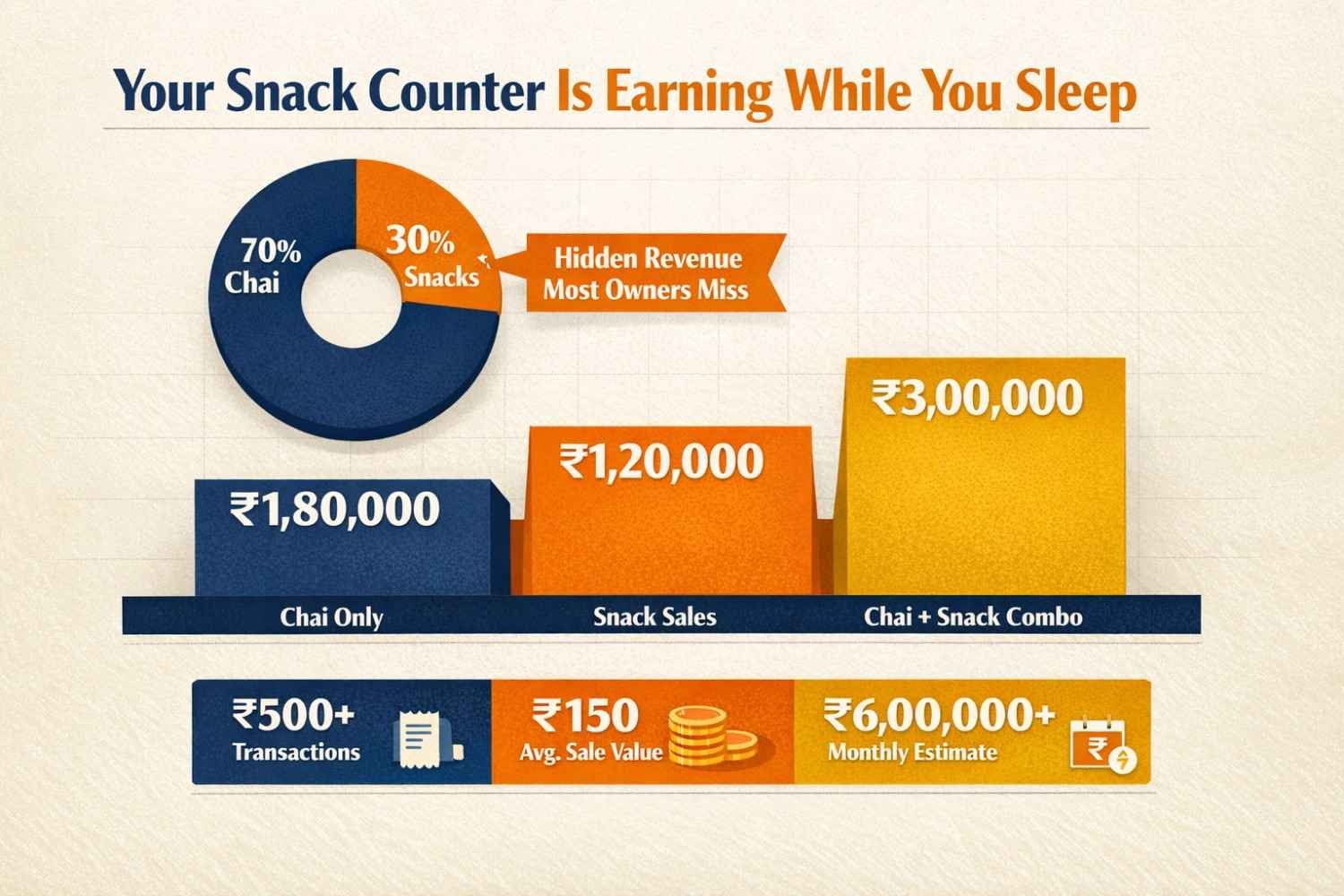
Let us put real numbers to this. Here is a sample daily revenue picture for a well-run Yewale outlet with 250 to 300 daily customers.
| Revenue Source | Daily Transactions | Avg. Per Sale | Est. Daily Revenue |
| Chai only sales | ~250 cups | ₹18 | ~₹4,500 |
| Yewale snack sales (Bakarwadi, Cream Roll, etc.) | ~80 to 90 items | ₹22 | ~₹1,800 to ₹2,000 |
| Chai + snack combo orders | ~60 combos | ₹40 | ~₹2,400 |
| Snack share of total daily revenue | 28% to 32% |
The numbers show that snack revenue alone can add INR 55,000 to INR 65,000 per month to an outlet's income. Over a year, that is close to INR 7 to 8 lakh in additional revenue from items that require no cooking, no chef, and in many cases, no extra effort beyond keeping the display shelf stocked.
Why Snack Margins Are Often Higher Than Beverage Margins
Here is the number that surprises most first-time franchise owners. The gross margin on bakery and snack items regularly reaches 40% to 50%, which is often higher than the margin on chai itself.
According to a QSR India market analysis by Mordor Intelligence, baked goods in the food service sector deliver gross margins of 40% to 50%, significantly higher than those of most hot beverages. This means that every Yewale Cream Roll or Spongy Cake sold is not just adding to your top-line revenue. It is contributing disproportionately to your actual profit.
What most people do not realize is this: in Yewale Amruttulya's zero-royalty model, every rupee of snack profit stays entirely with you. There is no revenue cut, no percentage shared with the franchisor. 100% of what you earn from snacks is yours to keep.
The Yewale Snack Menu: What Is on the Counter and Why Each Item Earns Its Place
A quick look at what Yewale Amruttulya's snack lineup actually does for daily revenue.
| Yewale Snack Item | Snack Role | Why Customers Buy It | Revenue Type |
| Bakarwadi | Cultural comfort snack | Deep Maharashtrian chai-time tradition | Repeat purchase |
| Cream Roll | Impulse buy item | Visual appeal, low price resistance | Impulse revenue |
| Jaggery Cream Roll | Exclusive Yewale item | Not available anywhere else | Loyalty + repeat visit |
| Spongy Cake | All-day snack | Soft, light, crosses all age groups | Steady daily revenue |
| Limbu Sarbat + snack combo | Seasonal pairing | Summer footfall driver | Seasonal spike revenue |
Bakarwadi: The Snack That Builds Emotional Loyalty
Bakarwadi is the cultural anchor of Yewale's snack menu. It has a long shelf life, zero preparation requirement at the outlet, and a deep Maharashtrian identity that no other snack on your counter can match. Customers who love it come back for it specifically. They also bring guests who have not tried it. Stock it prominently, keep it fresh, and let its cultural weight do the selling.
Cream Roll: The Impulse Buy That Needs No Convincing
Cream Rolls are positioned at the sweet spot of visual appeal and price accessibility. Under ₹25, there is almost no price resistance. Customers see it, want it, and order it without overthinking. A well-lit display shelf is the only salesperson this item needs. Outlets that position Cream Rolls at eye level at the counter consistently report higher snack attachment rates.
Jaggery Cream Roll: Yewale's Exclusive That Creates Repeat Visits
This deserves special attention. The Jaggery Cream Roll is an exclusive Yewale product. It is not available at any other major tea franchise in India. When a customer tries it and loves it, they cannot satisfy that craving anywhere else. That exclusivity is one of the most powerful drivers of repeat footfall a franchise can have. Unique products build specific cravings. Specific cravings create loyal, returning customers.
Spongy Cake: Revenue Across Every Daypart
Unlike spiced savory snacks, Spongy Cake crosses every demographic and every time of day. It works for the morning customer who skipped breakfast, the student looking for a light afternoon snack, and the older customer who wants something soft and not too heavy. It is one of the few items on the menu that generates steady revenue across the entire operating day, not just the evening rush.
Limbu Sarbat Combo: The Summer Revenue Spike
Here is an angle most tea franchise articles completely ignore. Seasonal pairings. When temperatures rise, Yewale's Limbu Sarbat paired with a light snack creates a completely different customer occasion than the standard chai order. This combination drives footfall during the hours when hot tea demand dips. Franchisees who actively promote summer snack-drink combos capture revenue that competitors simply leave on the table.
How Smart Yewale Franchisees Maximize Snack Revenue Every Day
Franchise owners who consistently see snack contributions above 30% share a few daily habits. None of them are complicated. They are small, consistent practices that compound over time.
• Stock timing: Keep the display fully stocked during the 7 to 10 AM morning rush and the 5 to 8 PM evening rush. These are the two windows where snack impulse rates are highest.
• Display placement: Position Cream Rolls and Spongy Cake at eye level on the counter. Customers should see them before they even look at the menu board.
• The friendly prompt: Train staff to suggest a snack as part of the order process naturally. Something like 'Chai ani snack?' works consistently without feeling like a hard sell.
• Combo framing: A visible combo price point near the counter increases attachment rates. Customers respond to perceived value.
• Festive stocking: Bakarwadi demand spikes predictably during Diwali, Ganesh Chaturthi, and other Maharashtrian festivals. Plan stock increases in advance and capture the seasonal revenue.
• Morning slot: Promote Spongy Cake as a light breakfast option. Many customers want something to eat alongside their morning chai but do not want a heavy meal. Spongy Cake fills that gap perfectly.
• Exclusivity messaging: Let customers know the Jaggery Cream Roll is a Yewale exclusive. When people understand they cannot get it anywhere else, they order it more often and mention it to others.
According to a Restaurant India QSR upselling report, suggesting sides and snacks in a natural, non-intrusive way can increase average order value by 10% to 12%. For an outlet doing INR 6,500 per day, that is an extra INR 650 to INR 780 daily, or approximately INR 20,000 to INR 24,000 per month, just from better prompting at the counter.
The Chef-Less Snack Advantage: Revenue Without Added Complexity
Here is a practical detail that most franchise comparison articles skip entirely. At Yewale Amruttulya, all snack items are centrally standardized and supplied. That means two very specific things for your daily operation.
First, you do not need a trained cook, a baker, or any specialized kitchen equipment to sell Cream Rolls, Bakarwadi, or Spongy Cake. There is no preparation complexity at the outlet level. A new franchisee in their very first week can already maximize snack revenue from day one.
Second, taste consistency is guaranteed. Every Cream Roll at every one of Yewale's 650+ outlets tastes the same. That consistency is what builds the customer trust that keeps people returning, because they know exactly what they are going to get every single time.
This is a meaningful operational advantage. Snack revenue at Yewale is engineered to be simple. You display, you sell, you earn. The complexity is handled centrally so you can focus on running a great outlet.
A chef-less, royalty-free franchise model where snacks sell themselves from the display shelf. This is the operational design that makes snack revenue genuinely accessible even for a first-time business owner.
Why the Best Tea Franchise in India Is Built on More Than Just Tea
The India QSR market reached USD 8.7 billion in 2024 and is on track to reach USD 16.3 billion by 2033, growing at a CAGR of 7.22%. Inside that growth, the tea cafe segment remains one of the highest-margin, lowest-barrier entry points available to a first-time entrepreneur.
Source: IMARC Group India QSR Market Report
But the difference between a tea outlet that grows steadily and one that stagnates is rarely about location or brand recognition alone. It is about whether the owner understands the full revenue picture.
Chai is the foundation. But Bakarwadi earns from cultural memory. Cream Rolls earn from impulse. The Jaggery Cream Roll earns from exclusivity. Spongy Cake earns from reliability. Limbu Sarbat combos earn from seasonality. Together, these items account for 28% to 32% of daily revenue without requiring a single extra employee, a bigger kitchen, or any additional marketing spend.
And with a zero-royalty model, every single rupee of that snack revenue belongs entirely to you.
Ready to earn from every cup AND every snack you serve? Explore the Yewale Amruttulya tea franchise under 8 lakhs and see how a proven snack-plus-chai model can work for you.
Key Takeaways
• Market scale: India's snack market is worth INR 46,571 crore in 2024 and growing at 8.63% annually. Tea outlets are perfectly positioned to capture that demand daily.
• Revenue share: Snacks contribute 28% to 32% of total daily revenue at a well-run tea outlet, with gross margins reaching 40% to 50% on bakery items.
• Each snack has a job: Bakarwadi drives cultural loyalty. Cream Roll drives impulse. Jaggery Cream Roll drives exclusivity-based repeat visits. Spongy Cake drives all-day steady revenue.
• Zero-royalty advantage: At Yewale Amruttulya, all snack profits stay with the franchisee. No cuts, no percentages. What you earn is yours.
• Chef-less model: Pre-standardized snacks eliminate training costs and quality variation, making snack revenue easy to generate from your first day of operation.
• Small habits matter: Display placement, friendly prompts, and combo framing can add INR 20,000 to INR 24,000 per month in snack revenue on top of regular chai income.
• The bigger picture: The best tea franchise in India is not just a beverage business. It is a complete chai-plus-snack experience that turns every customer visit into maximum revenue.
The next time you think about what makes a tea outlet profitable, do not stop at the cup count. Look at the display shelf beside the counter. That is where the other 30% is waiting.
Are you currently running or planning a tea business? What is the one change you can make this week to your snack display that could start shifting your daily revenue numbers?