Rahul had saved up Rs. 8 lakhs over three years working a government job in Nagpur. Every morning, he walked past two shops on his street. One was a gleaming coffee cafe with neon lights and a fancy espresso machine. The other was a modest chai stall where the same 40 people stood in line every single day, rain or shine, at 7 AM. Both sold drinks. But only one of them never seemed to have a slow day.
Rahul's story is not unique. Across India, thousands of aspiring entrepreneurs are asking the same question before putting their savings into a food and beverage franchise: should I go with chai or coffee?
This blog breaks that question down completely. We look at real investment numbers, real profit margins, and the facts that most franchise comparison articles skip over. By the end, you will know exactly which business makes more sense for you in 2026.
Quick Definition: A franchise is a business model where you pay a brand to use their name, recipe, and system to run your own outlet. You get the brand, they get a fee or royalty.
The Indian Beverage Market in 2026: Tea Still Rules
Before comparing franchises, you need to understand the market you are entering. According to IMARC Group, the India tea market was valued at USD 11.86 billion in 2025 and is projected to reach USD 15.44 billion by 2034. That is a steady, growing market driven by one simple fact: over 80% of Indian households drink tea every single day.
Coffee tells a different story. Urban India loves coffee, no doubt. Cafe culture has grown fast in metros. But the core market for coffee remains concentrated in cities like Bengaluru, Mumbai, Delhi, and Pune. In Tier 2 and Tier 3 cities, chai is still what people actually drink.
What most franchise comparison blogs miss is this: your customer base for chai is 10x wider than for coffee. That fact alone changes the entire profit conversation.
Here's the Surprising Truth Most Articles Don't Tell You
Coffee feels premium, and that feeling tricks a lot of new investors into thinking premium equals profitable. It does not. Premium often means higher costs, more equipment, more staff, and a smaller customer base. That is a hard equation to make work, especially if you are just starting out.
Investment Breakdown: Chai Franchise vs Coffee Franchise
Let us look at what it actually costs to open each type of franchise in India in 2026. These numbers will surprise you if you have only read glossy franchise brochures.
| Factor | Chai Franchise | Coffee Franchise |
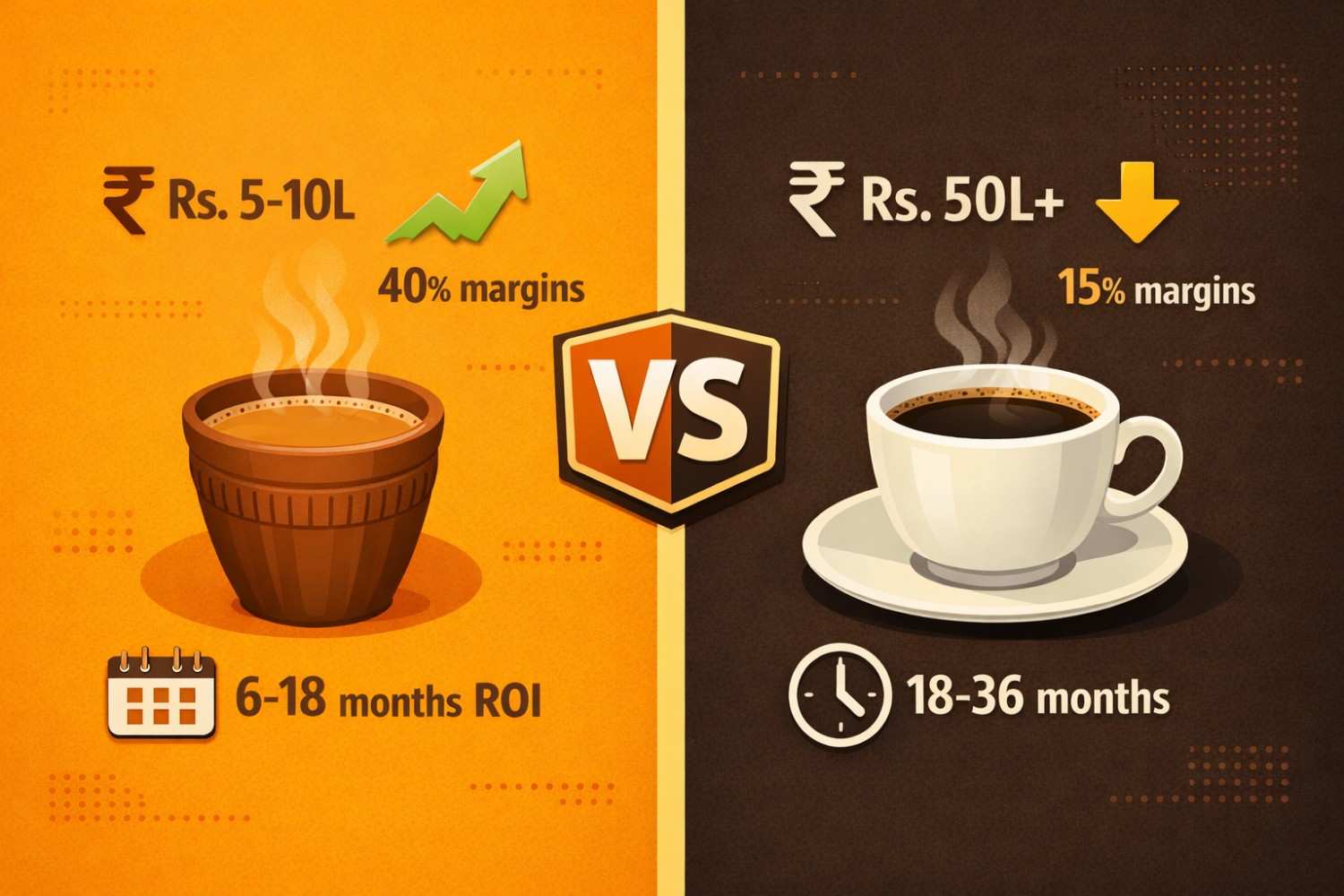
| Total Setup Cost | Rs. 5 to 10 lakhs | Rs. 15 to 100+ lakhs |
| Franchise Fee | Rs. 50K to 2 lakhs | Rs. 5 to 40 lakhs |
| Equipment Cost | Low (basic setup) | High (espresso machines, grinders) |
| Space Needed | 100 to 200 sq ft | 300 to 1500+ sq ft |
| Staff Required | 1 to 2 people | 3 to 8 people |
| Royalty Fee | Zero (many brands) | 5 to 15% of monthly revenue |
| Break-Even Period | 6 to 18 months | 18 to 36 months |
Sources: FranchiseBazar, Mysore Aduge Franchise Guide
The numbers tell a clear story. A coffee franchise from a known brand like Costa Coffee can cost you Rs. 1 to 2 crores to set up. A well-run chai franchise typically needs just Rs. 5 to 10 lakhs. That is a 10x to 20x difference in capital requirement.
Thinking about starting a chai franchise with zero royalty? Explore the Yewale Amruttulya franchise model. |
Profit Margins: Where Chai Wins Every Single Time
The real money question is not how much you invest. It is how much you keep after expenses. According to Salgar Tea's franchise research, most chai franchise outlets achieve 25 to 40% profit margins due to repeat customers and high daily footfall.
What Makes Chai Margins So Strong?
• Low raw material cost: A cup of chai costs roughly Rs. 3 to 5 to make and sells for Rs. 10 to 20. That margin holds even at high volume.
• No skilled labor needed: You do not need a trained barista to make chai. One person with basic training can run the entire operation.
• High repeat frequency: A chai customer comes back 2 to 3 times a day. A coffee customer, maybe once.
• No royalty model: Many chai franchises, including leading ones with 40-plus years in the market, operate on a zero royalty model. Every rupee you earn stays with you.
What Eats Into Coffee Franchise Profits?
• Imported coffee beans fluctuate in price with global commodity markets.
• Espresso machines need regular servicing, which is expensive.
• Premium interiors and ambiance require a higher rent budget.
• Royalty fees of 5 to 15 percent come off your monthly revenue before you count profits.
• Skilled baristas command higher salaries than general food service staff.
According to a profitability analysis by Baithack, tea franchises generally offer stronger net profit margins because the raw material cost is extremely low. Coffee franchises, while able to charge a premium price per cup, often struggle with lower net margins because operational costs are significantly higher.
Customer Base: Who Actually Buys Every Day?
What Most People Don't Realize Is That Chai Customers Are Built-In Loyal Buyers
In India, chai is not a choice. It is a habit. People drink it when they wake up, at 11 AM as a work break, after lunch, and in the evening. This built-in consumption pattern means a chai stall near an office, school, or residential area will always have customers.
Coffee customers are different. They go to a cafe for an experience. That means they are more selective about ambiance, seating, and Wi-Fi. Meeting those expectations adds cost. And on a Tuesday afternoon when nobody wants to step out, a coffee franchise can sit empty while the chai stall next door is still doing business.
| Customer Type | Chai Franchise | Coffee Franchise |
| Daily Visit Frequency | 2 to 3 times per day | Once a day or less |
| Age Group | All ages, all incomes | Mostly 18 to 35 urban adults |
| Location Flexibility | Anywhere in India | Mainly metros and Tier 1 cities |
| Spending Sensitivity | Low (Rs. 10 to 20 per cup) | High (Rs. 100 to 300 per cup) |
| Loyalty Driver | Habit and taste memory | Ambiance and experience |
| Ticket Size Dependence | High volume, low ticket | Low volume, high ticket |
Want to tap into India's 80% daily chai-drinking population? See how Yewale Amruttulya's 650+ outlets do it. |
The Tier 2 and Tier 3 City Advantage Nobody Talks About
Here is something that most franchise comparison articles ignore completely: your most profitable location might not be a metro city. Rent is lower, competition is lower, and the demand is just as real.
According to Hyderabadi Chai Adda's market research, chai cafes can flourish anywhere from busy city streets to college towns and highway stops. Coffee shops, on the other hand, thrive mostly in metros and upscale urban hubs. That geographic flexibility makes chai franchises ideal for entrepreneurs looking to scale with lower operating expenses.
If you are in Nagpur, Nashik, Kolhapur, Aurangabad, or any other Tier 2 city in Maharashtra, a chai franchise will reach more customers in your local market than a coffee brand would.
The Delivery Angle: Another Point Where Chai Wins
Tea travels well in spill-proof packaging. It stays good for takeaway and bulk office orders. Specialty coffee drinks like cappuccinos and lattes lose quality during delivery. That means chai franchises can tap into the online ordering and delivery market more effectively, adding another revenue stream without extra infrastructure.
The Royalty-Free, Chef-Less Model: A Game-Changer for First-Time Entrepreneurs
One piece of the franchise comparison that almost never gets discussed: the operational complexity difference between chai and coffee.
Running a coffee franchise usually requires at least one trained barista who knows how to work an espresso machine, dial in grind sizes, and steam milk to the right temperature. Hiring, retaining, and replacing that person is a real operational headache.
A well-structured chai franchise runs without a trained chef or barista. The recipe is standardized, the ingredients are pre-measured, and anyone can be trained to produce consistent results in a short time. For a first-time business owner, that simplicity is priceless.
What a Zero-Royalty Model Means for Your Monthly Take-Home
In a royalty-based franchise, a percentage of every rupee you earn goes back to the parent brand. On a monthly revenue of Rs. 1.5 lakhs, a 10% royalty means Rs. 15,000 leaves your account before you pay any expenses. Over a year, that is Rs. 1.8 lakhs gone.
In a zero-royalty chai franchise model, that Rs. 1.8 lakhs stays in your business. Over five years, you are looking at Rs. 9 lakhs in saved royalty costs alone. That is more than the total initial investment for many chai franchise models.
Ready to start a zero-royalty, chef-less chai business? Check out all Yewale Amruttulya products your outlet can serve. |
Chai vs Coffee Franchise: The Head-to-Head Verdict
| Parameter | Chai Franchise | Coffee Franchise |
| Startup Investment | Rs. 5 to 10 lakhs | Rs. 15 to 100+ lakhs |
| Royalty | Zero (many brands) | 5 to 15% monthly |
| Profit Margin | 25 to 40% | 10 to 25% |
| Break-Even Timeline | 6 to 18 months | 18 to 36 months |
| Staff Complexity | 1 to 2 people, basic training | 3 to 8 people, skilled barista |
| Market Size | All of India | Mainly metros |
| Daily Customer Frequency | 2 to 3 visits per day | Once a day or less |
| Delivery Suitability | High | Low for specialty drinks |
| Risk Level | Low | Medium to High |
Key Takeaways: What Should You Actually Do?
If you are an aspiring entrepreneur with a budget under Rs. 15 lakhs, a chai franchise is the clear choice in 2026. Here is why:
• Lower risk: You invest less and recover your money faster.
• Wider customer base: 80% of India drinks tea every day. Coffee is still growing but not at that scale.
• Simpler operations: No skilled barista, no expensive machine, no royalty eating your margins.
• Better location flexibility: You can open in a Tier 2 city and still run a profitable business.
• Proven demand: The Indian tea market is worth USD 11.86 billion and growing. That is not going away.
Coffee franchises are not a bad business. For someone with deep pockets, a love for cafe culture, and a prime metro location, they can work well. But for most first-time entrepreneurs in India, a chai franchise offers a faster, safer, and more profitable path.
India has been brewing chai for centuries. The opportunity to turn that cultural habit into a business has never been better organized or more accessible than it is right now.
So here is our question for you: if you could open a business tomorrow that sells something 80% of India already wants every single day, what would be stopping you?