Priya had spent three weeks researching franchise options in Pune. She had a budget of Rs. 8 lakhs and a dream of running her own food and beverage outlet. She shortlisted two brands. Both had good reviews. Both had decent-looking menus. But when she sat down to do the actual math, one thing jumped out at her that no brochure had mentioned clearly: one of the brands charged a 6% monthly royalty, and the other charged nothing at all.
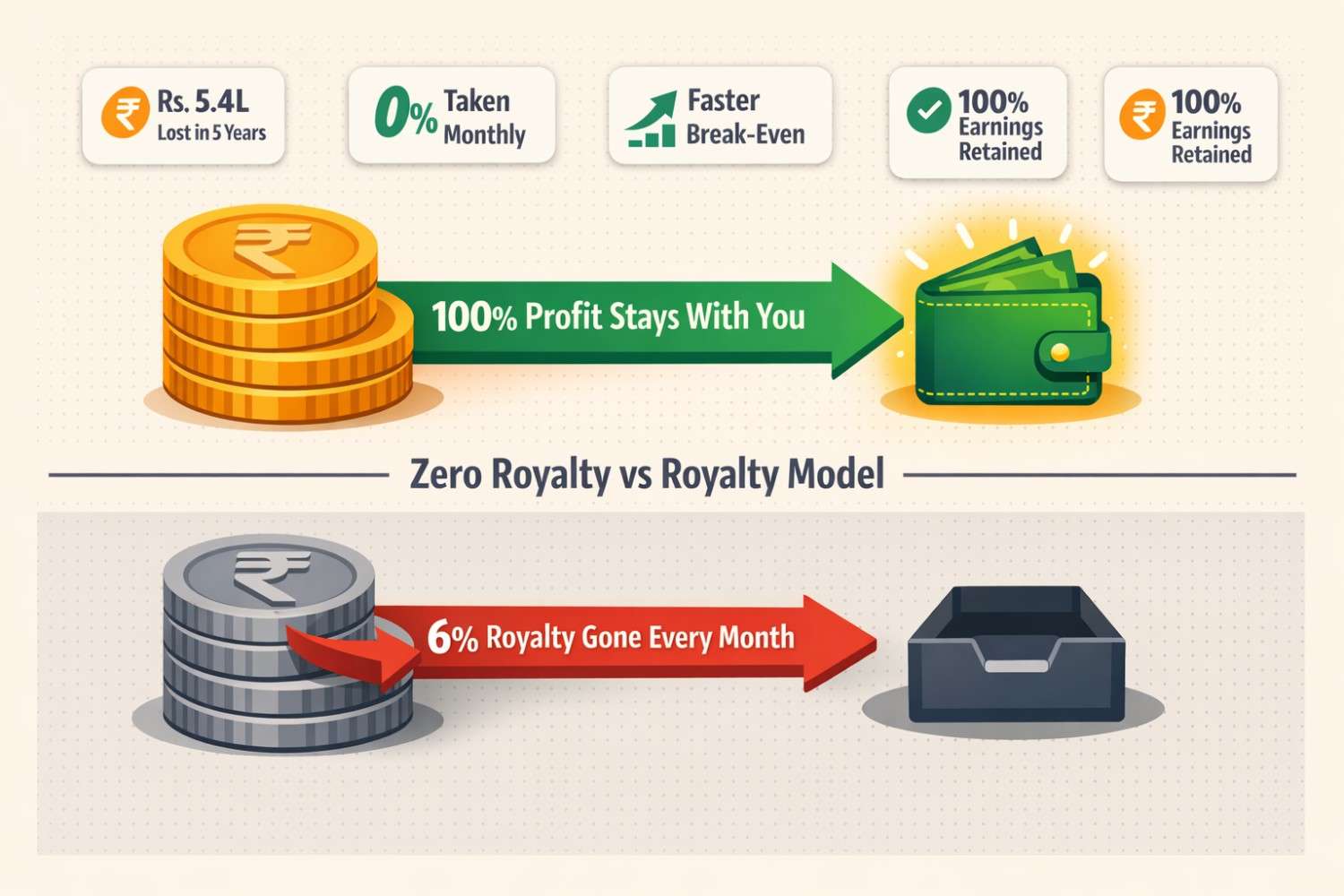
On paper, 6% sounds small. But Priya ran the numbers. At Rs. 1.5 lakh monthly revenue, 6% meant Rs. 9,000 leaving her account every single month. That is Rs. 1,08,000 per year. Over five years, she would pay Rs. 5.4 lakhs in royalty fees alone, on top of her initial investment. That money would never come back to her.
She chose the zero-royalty brand. And that one decision changed the entire profitability of her business.
Quick Definition: A royalty-free tea franchise is a business model where you pay a one-time setup or franchise fee to use the brand, but you do not pay any ongoing percentage of your monthly revenue back to the franchisor. Every rupee you earn stays with you.
What Exactly is a Franchise Royalty Fee?
Before understanding why royalty-free matters, you need to understand what a royalty fee actually is. According to FranConnect, a franchise royalty fee is a recurring payment that a franchisee makes to the franchisor, usually calculated as a percentage of gross monthly sales. The fee typically ranges between 4% and 12% of gross revenue across different industries, with food and beverage franchises usually sitting between 4% and 8%.
The key word here is gross revenue. That means the percentage is calculated on your total sales before you pay rent, salaries, ingredients, electricity, or any other expense. You pay royalty first, then you manage everything else from what is left.
The Three Most Common Royalty Models You Will See in India
• Percentage of gross sales: The most common model. You pay 3% to 8% of your monthly revenue to the brand every month, regardless of your expenses or profits.
• Fixed monthly royalty: A flat amount (say Rs. 5,000 or Rs. 10,000) is charged every month no matter how much or how little you sell.
• Hybrid model: A combination of a smaller fixed fee plus a lower percentage. Some food service brands in India use this structure to balance risk between both parties.
According to a detailed royalty fee guide by Sparkle Minds, royalty in India can range from 3% to 15% depending on brand prestige and the level of support offered. For a tea franchise owner running on thin margins, even 5% can make a significant difference in take-home profit.
The Real Math: What Royalty Actually Costs You Over Time
This is the section most franchise brochures skip. Let us do the math that Priya did, so you can see exactly what you are giving up.
Imagine you run a tea shop franchise in India with the following numbers:
| Factor | With 6% Royalty | Zero Royalty (You Keep All) |
| Monthly Revenue | Rs. 1,50,000 | Rs. 1,50,000 |
| Monthly Royalty Cost | Rs. 9,000 | Rs. 0 |
| Annual Royalty Paid | Rs. 1,08,000 | Rs. 0 |
| 5-Year Royalty Total | Rs. 5,40,000 | Rs. 0 |
| Net Profit (Monthly) | Lower by Rs. 9,000 | Full margin retained |
| Break-Even Impact | Delayed by 4 to 6 months | Faster break-even |
| 10-Year Royalty Total | Rs. 10,80,000+ | Rs. 0 |
What most people don't realize is that Rs. 10+ lakhs over ten years is more than the entire initial investment required to start many top tea franchise in India options. You are essentially paying for your franchise twice, just spread over time and hidden inside a small percentage.
Royalty is Charged on Revenue, Not Profit. That Detail Changes Everything.
Here is something that shocks most first-time franchise investors: royalty is not taken from your profit. It is taken from your revenue. So even in a slow month where you barely cover your costs, you still owe the royalty.
If your revenue is Rs. 80,000 in a slow month and your expenses are Rs. 75,000, your actual profit is Rs. 5,000. But with a 6% royalty, you owe Rs. 4,800 first. That leaves you with just Rs. 200 in actual take-home profit for the entire month. Without royalty, you would have kept the full Rs. 5,000.
Curious about a zero-royalty tea franchise model? See how Yewale Amruttulya structures its franchise program. |
Why a Royalty-Free Tea Franchise is a Smarter Choice in 2026
India is home to one of the world's largest tea markets. According to IMARC Group, the India tea market was valued at USD 11.86 billion in 2025 and is expected to reach USD 15.44 billion by 2034. With that kind of demand, the tea business itself is solid. The question is always: how much of the profit actually stays with the owner?
A royalty-free model gives you full ownership of your earnings from day one. Here is why that matters more in 2026 than ever before.
Reason 1: Raw Material Prices Are Rising
The cost of milk, tea leaves, sugar, and fuel have all seen price increases over the past two years. When your input costs go up, your margins naturally compress. In a royalty model, the brand still takes its percentage even as your costs rise. In a zero-royalty model, you absorb the cost increase but at least you are not also losing a percentage on top.
Reason 2: The First 12 Months Are Always the Hardest
Most new franchise owners take 6 to 18 months to fully stabilize their customer base and daily footfall. During this period, revenue is lower and the royalty bite feels much larger. Without royalty pressure, you can reinvest those savings into local marketing, better equipment, or simply building up a working capital buffer.
Reason 3: You Scale Faster Without the Drag
According to Tea Franchise Cost data on Yewale's own blog, profit margins for tea franchises generally range from 20% to 40% depending on location and management. A zero-royalty structure allows franchise owners to retain the upper end of that margin rather than watching a portion leave every month.
Reason 4: You Can Price More Competitively
When a portion of every sale goes to the parent company, there is pressure to either raise your prices or accept a thinner margin. Without royalty pressure, a tea shop franchise in India can keep its cup prices at levels that attract daily customers while still maintaining healthy profits.
Royalty-Free Doesn't Always Mean Free: What You Must Check
Here is the surprising truth about royalty-free tea franchises: not all of them are truly free of ongoing costs. Some brands label themselves royalty-free but build their revenue through other mechanisms. Before you sign anything, check for these hidden cost patterns.
| What to Check | Green Flag | Red Flag |
| Ingredient Sourcing | Open market sourcing allowed | Forced to buy from brand at inflated price |
| Marketing Fee | No separate marketing levy | Monthly marketing contribution required |
| Renewal Fee | Long-term agreement, low or no renewal | Annual renewal fee charged |
| Equipment | One-time setup, you own it | Leased from brand at extra cost |
| Training | Included in setup cost | Charged separately each cycle |
| Territory | Protected territory included | No exclusivity, brand can open next to you |
| Profit Sharing | No profit sharing | Band takes a share of monthly profit |
Ask these questions directly before signing any franchise agreement. A genuine royalty-free franchise will be transparent about all these points. If a brand hesitates or gives vague answers on any of these, treat it as a warning sign.
The Mandatory Supply Chain Trick: What Most Articles Never Mention
Some franchisors skip the royalty label but make franchisees buy all raw materials exclusively from them at marked-up rates. According to Sparkle Minds, this is a common workaround where brands essentially collect royalty through inflated ingredient prices rather than a direct fee. The financial impact is the same or worse. Always compare the brand's mandatory ingredient prices against open market rates before deciding.
Want to see the full product range your outlet would serve? Browse the Yewale Amruttulya menu before you decide. |
Why Tea is the Right Category for a Royalty-Free Franchise
Even within the royalty-free franchise world, the category you choose matters. A royalty-free fast food franchise is still expensive to run because of high raw material, equipment, and staffing costs. Tea is different.
• Ultra-low raw material cost: A cup of chai costs roughly Rs. 3 to 6 to produce and sells for Rs. 10 to 25. That margin holds consistently at volume.
• No skilled labor requirement: Unlike a coffee or dessert franchise, a tea stall franchise in India does not need a trained chef or barista. One trained operator can run an outlet efficiently.
• Daily repeat demand: Tea buyers return 2 to 3 times daily. Most food franchises rely on occasional visits. A chai outlet builds a reliable, predictable revenue stream.
• Small footprint: A well-run tea shop franchise in India can operate from 100 to 200 square feet. Smaller space means lower rent, which preserves your margin.
• Pan-India customer base: Unlike premium coffee or dessert categories which skew toward urban adults, chai appeals to every age group and income level across all of India.
With all these natural advantages baked in, a royalty-free structure on top of a tea franchise creates one of the most capital-efficient small business models available to first-time entrepreneurs in India today.
Five-Year Profit Comparison: Royalty vs Zero Royalty
Let us extend Priya's numbers into a realistic five-year scenario. We will keep the monthly revenue at a conservative Rs. 1.5 lakhs to show how much difference the royalty model makes over time.
| Year | Zero Royalty (Savings Retained) | 6% Royalty (Paid Out) |
| Year 1 | Rs. 0 royalty paid | Rs. 1,08,000 paid to brand |
| Year 2 | Rs. 0 royalty paid | Rs. 1,08,000 paid to brand |
| Year 3 | Rs. 0 royalty paid | Rs. 1,08,000 paid to brand |
| Year 4 | Rs. 0 royalty paid | Rs. 1,08,000 paid to brand |
| Year 5 | Rs. 0 royalty paid | Rs. 1,08,000 paid to brand |
| Total | Rs. 0 out of pocket | Rs. 5,40,000 paid to brand |
Rs. 5.4 lakhs over five years is enough to open a second outlet in many Tier 2 cities. In a royalty model, that money goes to the brand. In a zero-royalty model, it stays with you and funds your next growth step.
See where tea shop franchise locations are already running across India. Find a location near you. |
Key Takeaways Before You Invest in a Tea Franchise
If you are evaluating a tea shop franchise in India, here is what you should walk away knowing:
• Royalty fees are charged on gross revenue, not profit. Even in a bad month, you pay before yourself.
• A 6% royalty on Rs. 1.5L monthly revenue costs Rs. 5.4 lakhs over five years. That is money that could fund a second outlet.
• Not all royalty-free claims are genuine. Check for mandatory supply markups, marketing levies, and renewal fees.
• Tea is the ideal category for a royalty-free model because of low raw material costs, small space needs, and pan-India daily demand.
• The break-even period is significantly faster in a zero-royalty tea franchise compared to royalty-based models.
The best business decision you can make is not just about picking a famous name. It is about understanding what that name actually costs you every single month, and every single year, for as long as you are in business.
A royalty-free franchise does not mean the brand gives you less. It means they believe their model is strong enough that they do not need to take a cut of your earnings to stay profitable. That confidence is worth something on its own.
So here is the question worth sitting with: if two brands offer you the same product, the same support, and the same location opportunities, but one takes Rs. 5 lakhs from you over five years and the other takes nothing, which one would you choose?