Vikram was 35 years old when he walked into a Pune tea outlet on a cold January morning in 2025. He was not there because he was thirsty. He was there because he had spent six months reading about franchise businesses and was tired of getting answers like 'it depends' and 'results may vary.' He ordered a medium chai for fifteen rupees and asked the owner, as casually as he could, what kind of money the place was making.
The owner laughed, not unkindly, and said, 'Bhai, seedha poochhte ho to seedha batata hoon.' And he did. He showed Vikram the daily counter log, right there on a used notebook. Three hundred cups on a regular weekday. Four hundred on Saturdays. The math was not hard. Vikram pulled out his phone, punched in the numbers, and went very quiet for a while.
Eight months later, he owned his own outlet. And his notebook looked a lot like that one.
This article is the honest conversation Vikram needed before he started. We will use real numbers, real menu prices, and real market data from 2026 to walk you through what a tea franchise in India can actually earn, and what it takes to get there.
| Curious if a tea franchise fits your investment budget? Get the Yewale Amruttulya franchise details here. |
Why a Tea Business in India Is Built Different from Every Other F&B Option
Here is the surprising truth that most franchise comparison articles skip entirely: tea is not a food business. It is a habit business. And habit businesses are the most defensible kind.
According to the Tea Board of India, nearly 88% of Indian households drink tea every single day. The average adult in India drinks at least two cups daily, and research shows Indians consume 30 cups of tea for every one cup of coffee. That is a customer base that does not need to be created. It already exists, everywhere, and it shows up seven days a week.
The organized tea cafe market in India is now growing at over 15 to 20% CAGR per year, according to market research published in 2026. This is not the overall tea market. This is specifically the segment that includes branded tea outlets and franchises. The shift from unbranded roadside tapris to trusted branded counters is still very early, which means the growth window for new franchise owners is wide open right now.
The broader India tea market, according to Expert Market Research's 2026 report, is projected to grow at a CAGR of 4.50% between 2026 and 2035. Grand View Research puts the market on track to reach USD 20.46 billion by 2033, growing at 6.8% annually. At ₹12 to ₹40 a cup, your product is recession-proof. It is the last expense any Indian consumer cuts.
The 2026 Numbers Behind the Tea Franchise Opportunity
Before we get into your earnings, let us anchor this in the data that supports the business case. These are all sourced from 2025 and 2026 research.
India tea market size (2025 baseline): USD 11.86 Billion (~INR 78,000 crore) (IMARC Group)
Market CAGR for 2026 to 2035: 4.50% per year (Expert Market Research, 2026)
Projected market size by 2033: USD 20.46 Billion (Grand View Research)
At-home tea volume growth in 2026: 4.3% expected (Statista India Tea Forecast)
Organized tea cafe sector growth: 15 to 20% CAGR annually (Industry Research, 2026)
India domestic tea consumption: 1.2 billion kg per year (Tea Board of India via Statista)
Average tea franchise payback period in 2026: 8 to 20 months, based on location (Franchise Alpha, 2026)
2026-Specific Signal Worth Noting: Chai Point, one of India's largest tea cafe chains, is reported to be planning a public listing on the stock exchange by mid-2026, according to Franchise India. When a tea brand moves toward an IPO, it is a strong signal that institutional investors see long-term value in the category. For a franchise buyer at ₹7.9 lakh, this is the industry wind blowing in the right direction. |
Tea Franchise in India 2026: Side-by-Side Brand Comparison
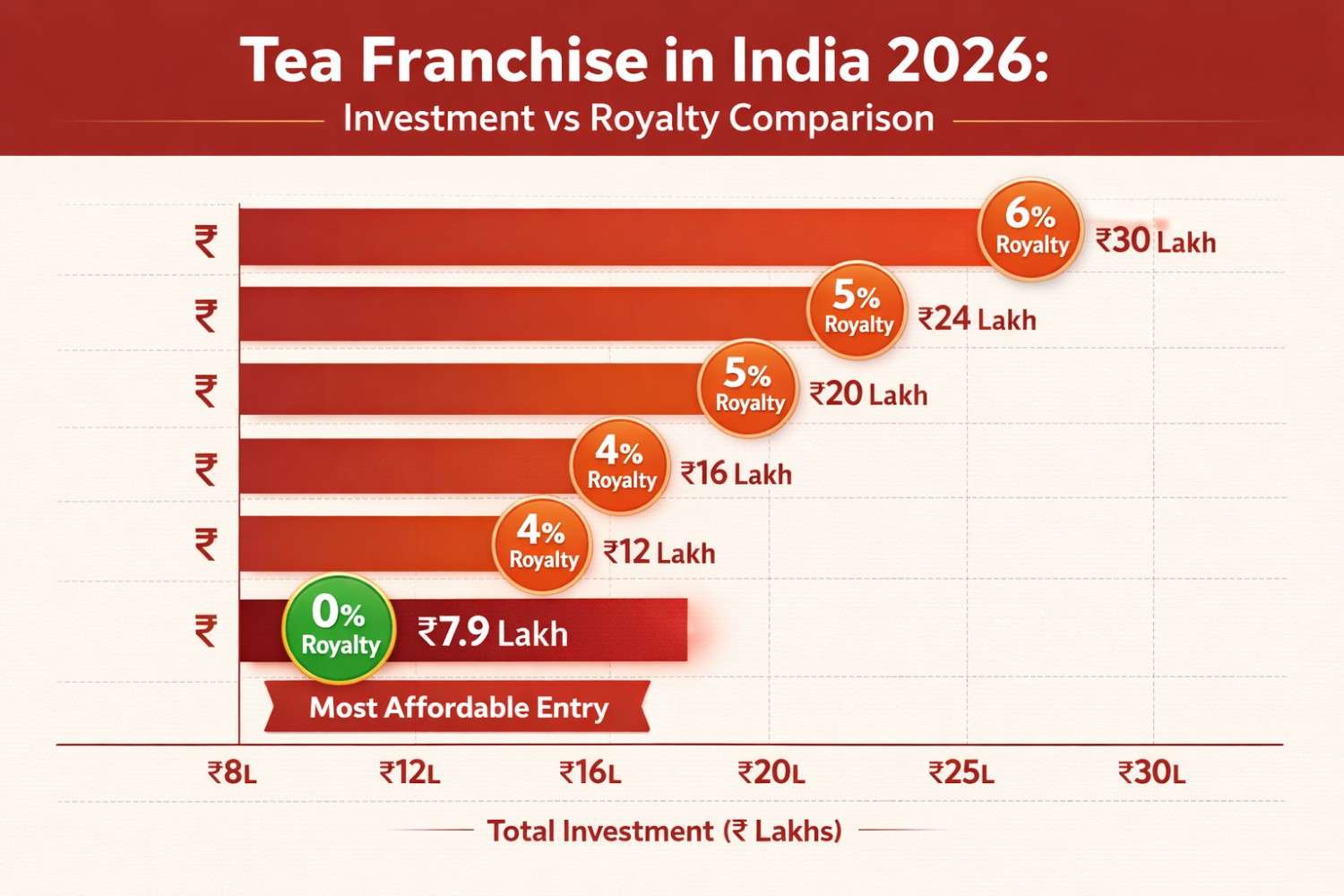
Here is how the major tea franchise brands in India compare right now. This table uses updated 2026 data from franchise publications, brand websites, and industry reports.
| Brand | Investment (2026) | Royalty | Space Needed | Break-Even | Key Differentiator |
| Yewale Amruttulya | ₹7.9 Lakh | 0% (Zero) | 200-300 sq ft | 10-11 months* | Lowest cost + zero royalty |
| Chai Sutta Bar | ₹20-30 Lakh | 4% monthly | 400-2000 sq ft | 18-24 months | Strong brand recall, kulhad serving |
| MBA Chaiwala | ₹14-25 Lakh | Applicable | 100-300 sq ft | 16-18 months | Youth-facing brand identity |
| Chaayos | ₹6-11 Lakh | 5% monthly | 200-400 sq ft | 12-18 months | Premium customization menu |
| Chai Point | ₹25-30 Lakh | 6% monthly | 600-800 sq ft | 18-24 months | Technology-led, IPO planned 2026 |
| Tea Post | ₹10-15 Lakh | Not disclosed | 1000-1500 sq ft | 18-24 months | Full food menu alongside chai |
| Tea Planet | ₹6-12 Lakh | 0% | 300-1000 sq ft | 12-18 months | Specialty and bubble tea focus |
Sources: Franchise India, Unlock Franchise, brand websites (2025-2026). *Realistic mid-footfall scenario. See earnings section below.
The Royalty Math Nobody Puts in a Table: A 4% royalty on monthly revenue of ₹1,78,000 costs you ₹7,120 every month. That is ₹85,440 per year going straight to the franchisor before you count a single rupee of personal income. Over three years, you lose ₹2.56 lakh. Over five years, it is ₹4.27 lakh. Yewale Amruttulya charges ₹0 in royalty. Every rupee your outlet earns beyond operating costs stays with you. On a high-footfall outlet earning ₹2.97 lakh per month, the 5-year royalty savings vs a brand charging 5% comes to over ₹8.9 lakh in your pocket. |
What Can You Actually Earn? Three Real Scenarios with Actual Numbers
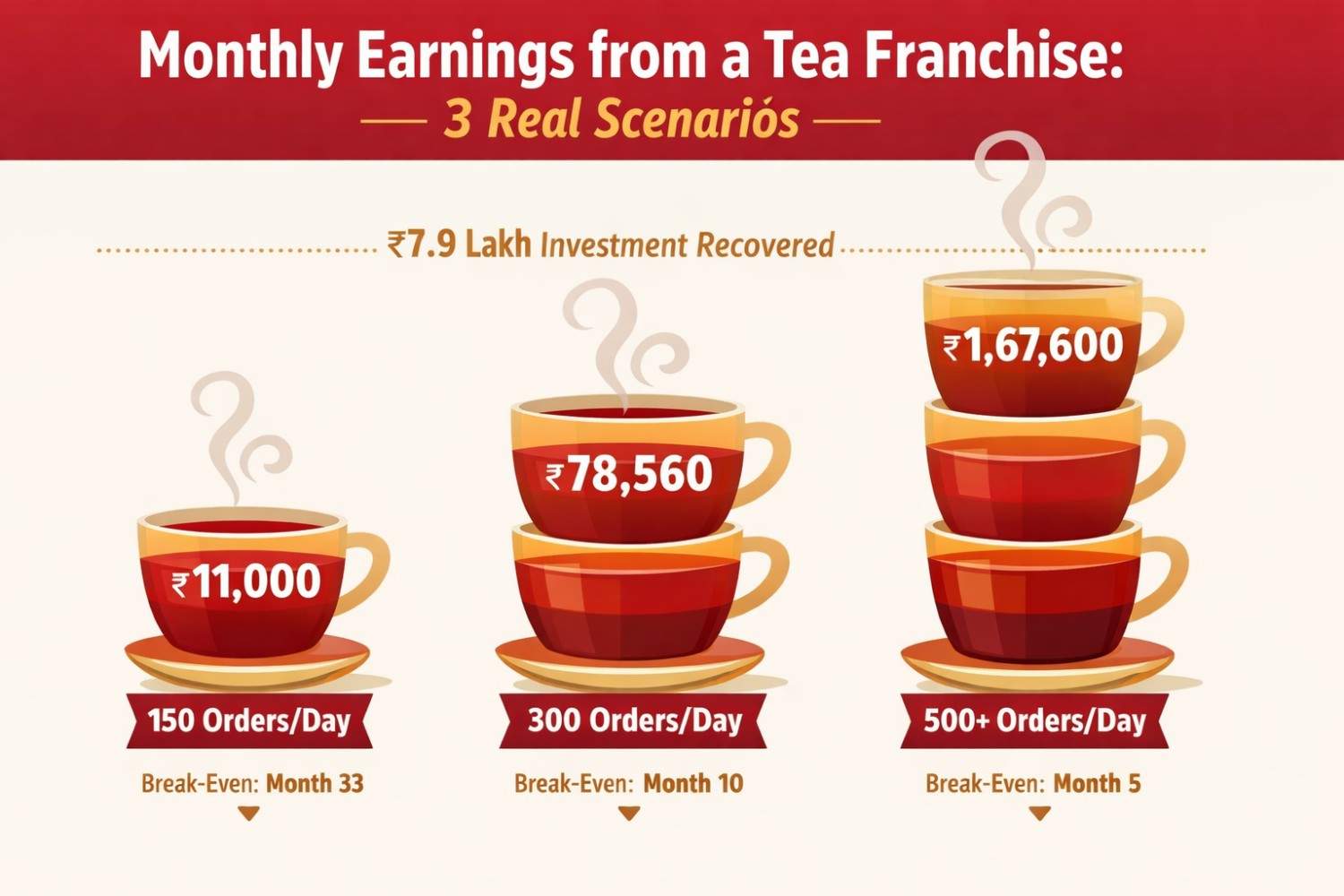
All calculations below use real Yewale Amruttulya menu prices from the official menu card. The product mix assumed is 60% core chai, 20% ginger/jaggery/specialty variants, 12% cold beverages, and 8% coffee and milk drinks.
Menu prices used: Yewale Special Chaha Small ₹12 / Medium ₹15 / Large ₹28. Ginger Tea ₹25. Jaggery Tea ₹15 to ₹30. Black Tea ₹20. Chocolate Tea ₹30. Lemon Honey Mint Tea ₹25. Cold Coffee ₹40. Rose Milk Shake ₹40. Peach Ice Tea ₹30. Kairiche Panhe ₹30. Limbu Pani ₹20. Masala Milk ₹30. Haldi Doodh ₹25. Hot Coffee ₹25. View the full product range here.
Scenario 1: Conservative — New Outlet, Moderate Foot Traffic
| Variable | Per Day | Per Month |
| Total orders | 150 cups / orders | -- |
| Core chai revenue (avg ₹15) | ₹1,350 | ₹40,500 |
| Specialty variants — Ginger, Jaggery (avg ₹25) | ₹750 | ₹22,500 |
| Cold beverages — Cold Coffee, Ice Tea (avg ₹30) | ₹540 | ₹16,200 |
| Coffee + Milk drinks (avg ₹28) | ₹336 | ₹10,080 |
| TOTAL REVENUE | ₹2,976 | ₹89,280 |
| Estimated operating costs (rent, staff, raw materials, utilities) | -- | ~₹78,000 |
| NET MONTHLY PROFIT | -- | ~₹11,280 |
Scenario 2: Realistic — Mid-Traffic Location Near Market, Transit Hub, or Office Area
| Variable | Per Day | Per Month |
| Total orders | 300 cups / orders | -- |
| Core chai revenue (avg ₹15) | ₹2,700 | ₹81,000 |
| Specialty variants (avg ₹25) | ₹1,500 | ₹45,000 |
| Cold beverages (avg ₹30) | ₹1,080 | ₹32,400 |
| Coffee + Milk drinks (avg ₹28) | ₹672 | ₹20,160 |
| TOTAL REVENUE | ₹5,952 | ₹1,78,560 |
| Estimated operating costs | -- | ~₹1,00,000 |
| NET MONTHLY PROFIT | -- | ~₹78,560 |
Scenario 3: High Footfall — IT Park, Railway Feeder Road, Busy Junction
| Variable | Per Day | Per Month |
| Total orders | 500+ cups / orders | -- |
| Core chai revenue (avg ₹15) | ₹4,500 | ₹1,35,000 |
| Specialty variants (avg ₹25) | ₹2,500 | ₹75,000 |
| Cold beverages (avg ₹30) | ₹1,800 | ₹54,000 |
| Coffee + Milk drinks (avg ₹28) | ₹1,120 | ₹33,600 |
| TOTAL REVENUE | ₹9,920 | ₹2,97,600 |
| Estimated operating costs | -- | ~₹1,30,000 |
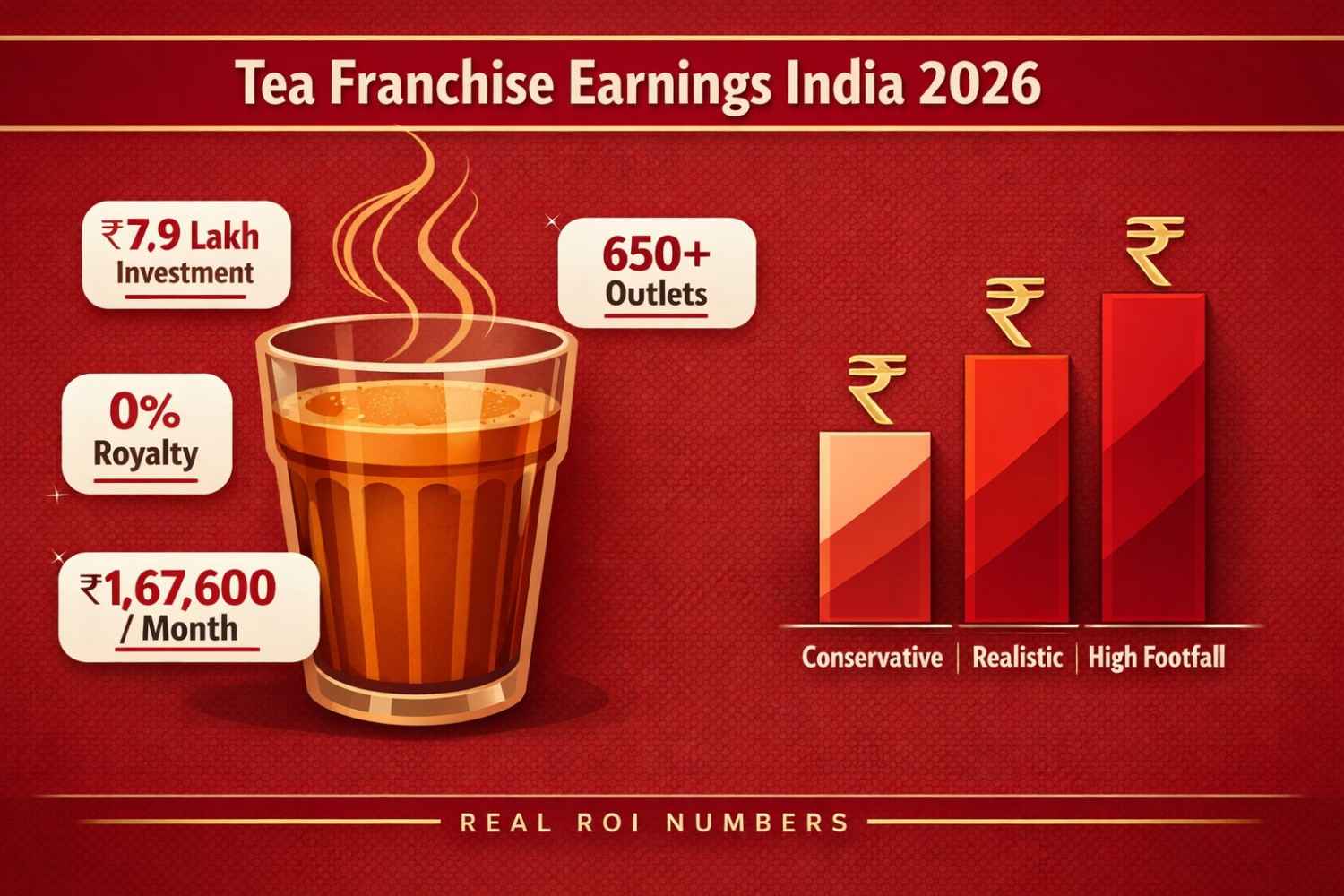
| NET MONTHLY PROFIT | -- | ~₹1,67,600 |
Break-Even Summary on ₹7.9 Lakh Investment
| Scenario | Monthly Profit | Break-Even Period | Annual Return |
| Conservative (150 orders/day) | ~₹11,280 | ~30-35 months | ~₹1.35 Lakh |
| Realistic (300 orders/day) | ~₹78,560 | ~10-11 months | ~₹9.43 Lakh |
| High Footfall (500+ orders/day) | ~₹1,67,600 | ~5-6 months | ~₹20.1 Lakh |
For context, Franchise Alpha's 2026 guide reports that average tea franchises across brands recover their investment in 8 to 20 months depending on location and format. Yewale's realistic scenario of 10 to 11 months sits right in that benchmark, on an investment that is 60 to 75% lower than most other branded alternatives.
| Want to know what your city's outlet could earn? Talk to a Yewale franchise advisor and get a location-specific projection. |
Five Things Most Tea Franchise Articles in 2026 Still Do Not Tell You
1. Your Cold Beverage Menu Earns More Per Cup Than Chai
When summer arrives and hot chai demand dips, most tea stall owners lose revenue. That does not happen when your menu includes Cold Coffee at ₹40 and Rose Milk Shake at ₹40, priced 167% higher than a small regular chai at ₹15. Selling 100 cold coffees on a hot May afternoon generates ₹4,000. Getting the same from small chais means serving 267 cups. The summer cold beverage menu is not a backup plan. It is your highest-revenue window of the year if you activate it properly.
2. The Multi-Size Upsell Adds ₹20,000 to ₹24,000 Per Month Without Extra Customers
The Yewale menu offers three cup sizes for its signature chai: Small ₹12, Medium ₹15, and Large ₹28. That is a 133% price jump from the smallest to the largest. Training your counter person to ask one question, 'Large mein upgrade karein?', to just 50 customers per day adds ₹800 in daily revenue. Over 30 days, that is ₹24,000 extra every month from a single sentence. No new customers. No new products. Just one question.
3. The Chef-Less Model Quietly Saves You ₹1.2 to ₹2.16 Lakh Per Year
A standard food franchise needs a trained cook or chef at ₹20,000 to ₹30,000 per month. Yewale's proprietary tea powder and standardized recipe system means a trained counter helper at ₹10,000 to ₹12,000 can run the entire operation with no drop in cup quality. That wage difference of ₹10,000 to ₹18,000 per month adds up to ₹1.2 to ₹2.16 lakh per year that goes straight into your profit, and it never shows up in any franchise comparison table.
4. A Loyal Base of Just 100 Regular Customers Locks In ₹1.62 Lakh in Annual Revenue
Tea is a daily habit. If 100 customers visit your outlet every morning for a medium chai at ₹15, that one group alone generates ₹1,500 per day, ₹45,000 per month, and ₹5.4 lakh per year, guaranteed, before a single new customer walks through the door. No restaurant or food franchise can build that kind of predictable baseline revenue from such a small loyal group. Daily consumable products create the most dependable income base in any business.
5. The Jaggery Tea Premium Is Built into the Menu and Customers Pay It Willingly
The Gulacha Chaha (Jaggery Tea) is priced at ₹15 (small), ₹24 (medium), and ₹30 (large), compared to ₹12, ₹15, and ₹28 for regular chai. Health-aware customers pay this premium without negotiating because jaggery tea carries a wellness perception. According to the Small Tea Growers' Association, demand for health-positioned tea products in India is growing at 10 to 12% annually. Jaggery tea puts you inside that growth segment at zero additional cost to your franchise setup.
How Your Tea Shop Menu Protects Revenue in Every Season of 2026
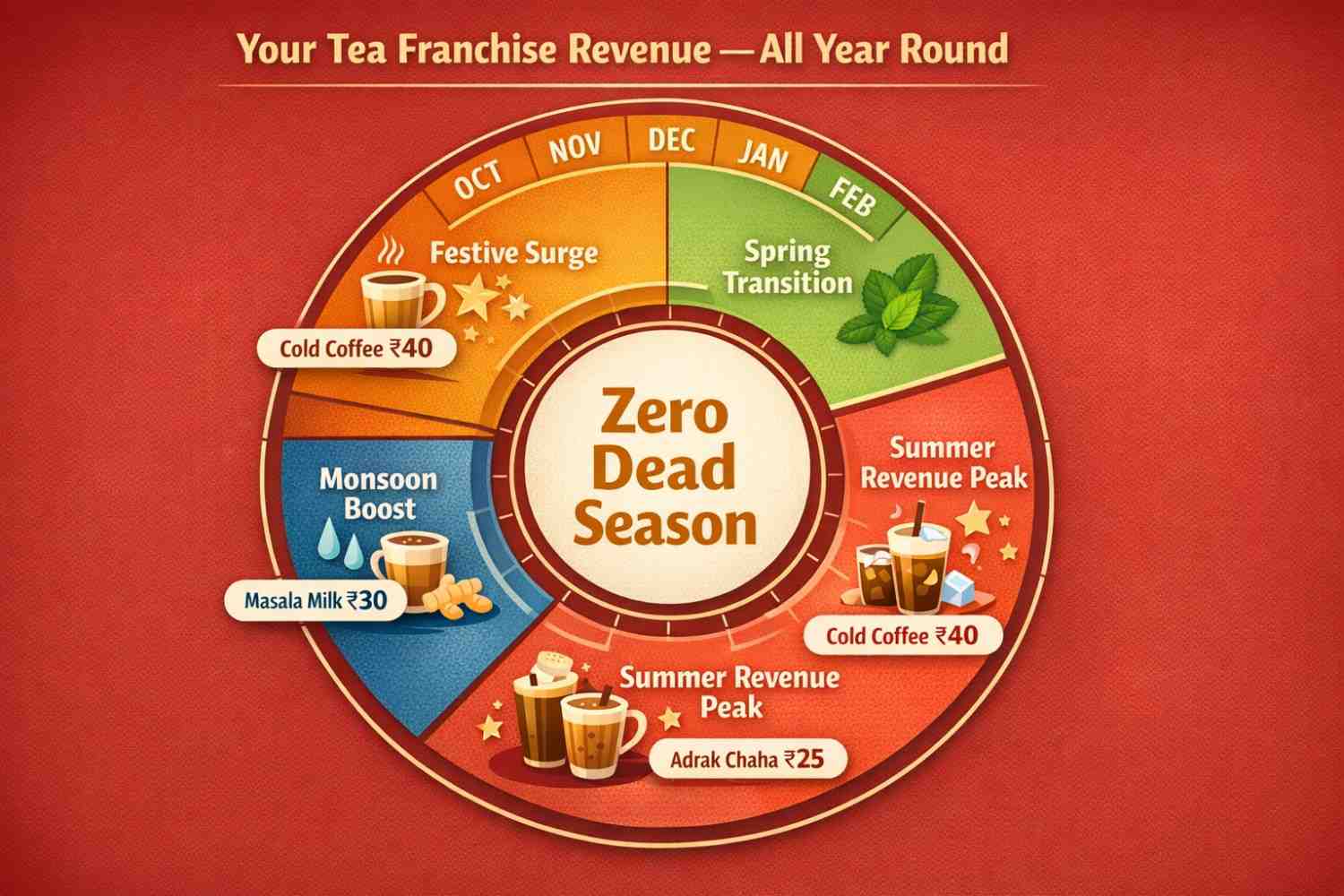
The single biggest fear most tea franchise buyers have is simple: what happens to my revenue when the weather gets hot and nobody wants chai? Here is the honest seasonal breakdown.
| Season | Months | Your Best-Selling Products | Revenue Impact |
| Peak Chai Season | Oct to Feb | Yewale Special Chaha (₹12-₹28), Adrak Chaha (₹25), Masala Milk (₹30), Haldi Doodh (₹25) | Highest cup volume of the year. Morning and evening rush overlap. |
| Spring Transition | Mar to Apr | Lemon Honey Mint Tea (₹25), Black Tea (₹20), Hot Coffee (₹25) | Lower raw material cost per cup means higher margin per sale. |
| Summer Revenue Peak | May to Jul | Cold Coffee (₹40), Rose Milk Shake (₹40), Peach Ice Tea (₹30), Kairiche Panhe (₹30), Limbu Pani (₹20) | Your highest average ticket size. Cold beverages earn more per cup than chai. |
| Monsoon | Jul to Sep | Adrak Chaha (₹25), Jaggery Tea (₹15 to ₹30), Hot Coffee (₹25) | Immunity and warmth drive chai demand back up strongly. |
| Festive Season | Sep to Nov | Masala Milk (₹30), Chocolate Tea (₹30), Turmeric Milk (₹25) | Footfall surges. Premium variants push average order value higher. |
The insight most articles miss: In May and June, your Cold Coffee at ₹40 and Rose Milk Shake at ₹40 are the most expensive items on the entire menu. A customer who comes for hot chai in December spends ₹15. The same customer in June, switching to a cold coffee, spends ₹40. Your average revenue per customer actually goes up in summer, not down, if your cold beverage counter is visible and ready to serve. |
Four Factors That Directly Determine Your Monthly Income
Location Type Is the Biggest Variable You Will Ever Choose
A tea shop franchise near an IT park, railway station, college gate, or busy market intersection consistently earns 2 to 3 times more per day than one in a quiet residential lane. Before you sign any lease, physically visit the location at 7 AM, 12 PM, and 5 PM on three different days. Those are your three peak revenue windows. If foot traffic is thin in all three, the location is wrong regardless of how good the rent looks.
Peak Hour Staffing Determines How Much Revenue You Actually Capture
An outlet that is stocked, staffed, and ready to serve during the 7 to 9 AM, 12 to 2 PM, and 4 to 7 PM windows earns 35 to 40% more than one that misses even one of those slots. Tea buyers do not wait. If your counter is not ready when they arrive, they walk to the next option. Consistency at peak hours is not a nice-to-have. It is your primary revenue lever.
Seasonal Menu Activation Is Worth ₹15,000 to ₹25,000 Extra Per Month
Franchisees who actively display and promote seasonal products, Kairiche Panhe in April, Cold Coffee in June, Masala Milk in November, see 15 to 25% higher revenue during those months than franchisees who leave the full-year menu unchanged. It does not happen by itself. You need to make the seasonal product visible at the counter and make sure your staff offers it alongside every chai order.
The Upsell Habit Is Worth More Than Any Marketing Campaign
Training your counter staff to consistently offer the large cup size or pair a cold beverage with every chai order adds ₹15,000 to ₹25,000 to your monthly revenue without serving a single extra customer. Building this habit takes two to four weeks of practice. Once it is running, it runs automatically. No ad budget needed.
Who Is a Tea Shop Franchise in India Best Suited for in 2026?
• Salaried professionals who want a secondary income without daily involvement, because the chef-less model means one trained helper can run the counter while you supervise remotely
• First-time entrepreneurs with ₹8 to ₹10 lakh in savings who want an established brand behind them rather than starting from scratch with no recognition
• People in Tier 2 and Tier 3 cities where rent is lower, chai culture is stronger, and the break-even timeline is faster than in metros
• Homemakers and retired individuals who want a low-complexity daily-revenue business that does not require cooking skills or technical expertise
• Former unbranded tea stall owners who want to upgrade with standardized quality, brand trust, and the ability to charge a sustainable price premium over local tapri competition
The Honest Part: Real Risks You Should Factor In Before You Start
Any article that shows only upsides is trying to sell you something. Here are the real risks every tea franchise buyer should plan for.
Wrong location: A poorly located outlet can stay in the conservative scenario for 30 or more months. Location research is not optional. Walk the spot across different time windows on multiple days before you commit to any lease.
The first three months are slowest: New outlets need time to build a regular customer base. Budget for a three-month runway where profits are thin. Cutting corners on staff or stock during this period usually extends the runway further, not shorter.
Summer requires active cold menu management: The cold beverage revenue spike does not happen automatically. Your counter staff needs to offer cold drinks proactively, your cold menu needs to be visible, and your stock needs to be ready. If you leave the hot chai menu display unchanged in May, your summer earnings will disappoint.
Staff consistency matters even in a two-person operation: Even with just one or two helpers, a reliable counter person who greets customers well and works the upsell habit makes a measurable difference in daily revenue. Budget time for proper onboarding of every new hire. |
The Bottom Line for 2026
A tea franchise in India is not a passive investment. It is a daily-revenue business built on one of the world's most powerful consumer habits. The math, when done honestly, is straightforward.
At a mid-footfall location with 300 orders per day, a franchise owner can expect roughly ₹75,000 to ₹80,000 in net monthly profit after all operating costs, on a ₹7.9 lakh investment, with zero royalty deducted. That is ₹9 to ₹9.6 lakh per year. Break-even comes around month 10 to 11.
At a high-footfall location with 500 or more orders per day, those numbers move to ₹1.5 to ₹1.7 lakh monthly net profit, with break-even in 5 to 6 months.
The organized tea cafe market is growing at 15 to 20% CAGR per year in 2026. The shift from unbranded tapris to trusted branded outlets is still early. Check which cities currently have Yewale franchise openings here. The opportunity window for first-movers in most Tier 2 and Tier 3 locations is still wide open.
The single biggest variable is location. Get that right, and a business built on a product that 88% of the country drinks every single day will take care of the rest.
So here is the question worth sitting with today: If you can start a business that sells something 1.2 billion kilograms of which is consumed in this country every year, for under ₹8 lakh, with no chef required and no royalty ever deducted, what exactly are you still waiting for?
| Your tea franchise journey starts with one conversation. Fill in the Yewale Amruttulya franchise enquiry form and get the full 2026 details. |
Sources Cited in This Article
1. IMARC Group — India Tea Market Size, Share and Forecast 2026-2034
2. Expert Market Research — India Tea Market Report and Forecast 2026-2035
3. Grand View Research — India Tea Market Size and Outlook 2026-2033
4. Statista — India Tea Market Forecast 2026
5. Tea Board of India — Consumption Volume of Tea in India FY 2015-2022 (via Statista)
6. Franchise Alpha — Tea Franchise in India: Top Brands, Costs and ROI in 2026
7. Franchise India — 7 Best Tea Franchise Opportunities in India (2025-2026)
8. Unlock Franchise — Chai Sutta Bar Franchise: Cost, Profit and How to Apply
9. Marketing Hack — 13 Best Tea Franchise in India: Cost and Top Brands List 2026
10. Yewale Amruttulya Blog — Tea Franchise Cost in India: A 2025-2026 Guide